When Do Babies Start Sleeping Through the Night? A Realistic Guide for Exhausted Parents (2026)
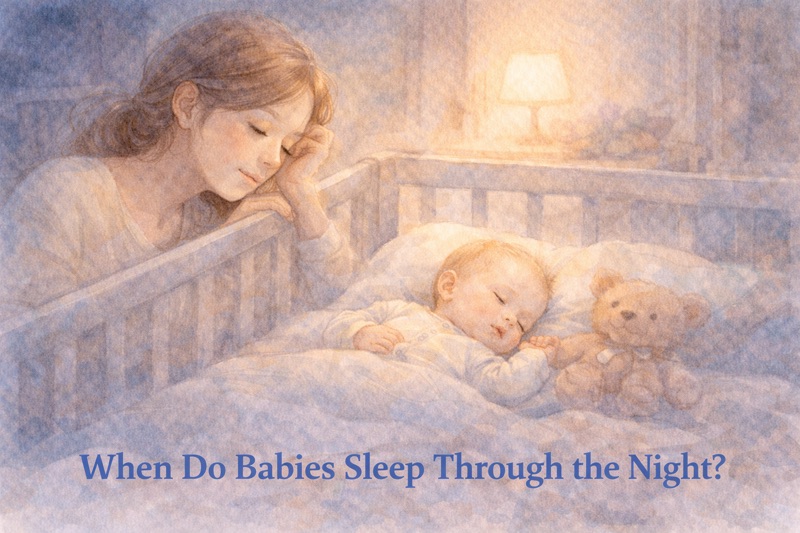 If you’re reading this at 2 AM while rocking a wide-awake baby, you’re not alone.
One of the most common questions new parents ask is:
“When will my baby finally sleep through the night?”
The short answer: it depends.
The honest answer: sooner than you think — but not in the way you expect.
This guide explains what “sleeping through the night” really means, what is normal at each age, and how you can help your baby (and yourself) get better sleep.
What Does “Sleeping Through the Night” Actually Mean?
Many parents imagine 10–12 uninterrupted hours.
But pediatric sleep experts define it differently:
✔ 5–6 hours of continuous sleep
✔ no feeding required
✔ ability to self-settle
That means your baby might still wake briefly — and that’s normal.
Baby Sleep Expectations by Age
🍼 Newborn (0–2 months)
Normal sleep pattern:
- 14–17 hours per day
- wakes every 2–3 hours to feed
- no day/night rhythm yet
✔ Night waking is biologically necessary
✔ Sleep training is NOT recommended
🌙 2–4 Months
What changes:
- circadian rhythm begins developing
- longer night stretches (3–5 hours)
✔ bedtime routine becomes helpful
✔ sleep regression around 4 months is common
🌟 4–6 Months
Major milestone period
Many babies begin:
- sleeping 6–8 hour stretches
- self-soothing
- establishing predictable schedules
✔ this is when sleep habits truly form
🌜 6–12 Months
Most babies can sleep:
- 10–12 hours overnight
- with 0–1 brief wakings
But remember:
✔ teething
✔ growth spurts
✔ separation anxiety
can temporarily disrupt sleep.
Why Some Babies Wake More Than Others
Night waking does NOT mean something is wrong.
Common reasons include:
✔ hunger or growth spurts
✔ sleep associations (rocking, feeding to sleep)
✔ overtiredness
✔ developmental leaps
✔ teething discomfort
Sleep is developmental, not mechanical.
How to Help Your Baby Sleep Longer
✅ Create a simple bedtime routine
Babies thrive on predictability.
Example:
- bath
- pajamas
- dim lights
- feeding
- quiet cuddle
✅ Watch wake windows
Overtired babies sleep worse.
General guide:
- newborn: 45–60 minutes
- 3 months: 60–90 minutes
- 6 months: 2–3 hours
✅ Put baby down drowsy but awake
This helps babies learn to connect sleep cycles.
✅ Keep nights boring
Night wakings should be:
✔ quiet
✔ dim
✔ calm
Save stimulation for daytime.
When Will My Baby Sleep Through the Night?
Most babies reach this milestone between:
👉 4 and 8 months
Some earlier.
Some later.
Both can be completely normal.
A Reality Check for Tired Parents
Baby sleep is not linear.
Just when you think you’ve “figured it out,”
a growth spurt, regression, or new milestone appears.
This is normal.
You are not doing anything wrong.
The Truth No One Tells You
Sleeping through the night isn’t the first goal.
✔ feeling safe
✔ building attachment
✔ learning to self-regulate
These are the real milestones.
Sleep follows.
Final Thoughts
If your baby wakes at night, you are not alone.
If you are exhausted, you are not failing.
If sleep feels unpredictable, that is because development is happening.
And one day — sooner than you think —
you will wake up before your baby does.


댓글
댓글 쓰기