When Can Babies Start Solid Foods? A Complete Guide for First-Time Parents [2026]
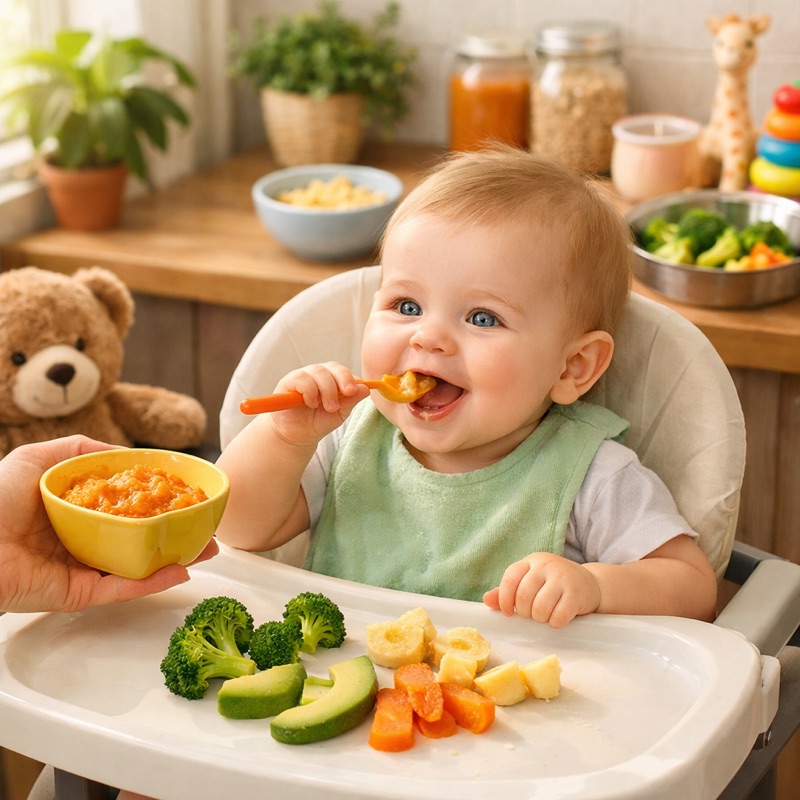 When can babies start solid foods? This guide explains the signs of readiness, the best first foods, what to avoid, and simple tips to make weaning safe and stress-free.
One of the most exciting — and nerve-wracking — milestones in your baby’s first year is starting solid foods. You’ve spent months mastering breastfeeding or formula feeding, and now everyone around you is saying, “Isn’t it time to give that baby some real food?”
But when exactly is the right time? What do you start with? And what happens if they just spit everything back out?
I’ve been there. And I want to share everything I wish someone had told me before I handed my baby a spoon for the very first time.
-----
## When Should Babies Start Solid Foods?
The short answer: most babies are ready to start solid foods somewhere around **6 months of age**. But the truth is, age alone isn’t the deciding factor — readiness is.
The World Health Organization (WHO) recommends exclusive breastfeeding for the first 6 months, and most pediatricians agree that starting solids before 4 months is too early, as a baby’s digestive system simply isn’t ready. Starting too early has been linked to an increased risk of obesity, digestive issues, and food allergies later in life.
On the other hand, waiting too long — past 7 or 8 months — can also create challenges. Babies can become more resistant to new textures, and they may not get enough iron and zinc from milk alone.
So the sweet spot is generally **between 5 and 6 months**, once your baby shows clear signs of readiness.
-----
## Signs Your Baby Is Ready for Solid Foods
Before you reach for that first spoonful of pureed sweet potato, check whether your baby is showing these key developmental signs. You want to see most of these, not just one or two.
**Good head and neck control.** Your baby should be able to hold their head steady and upright without support. If their head is still wobbling, their core isn’t strong enough yet to handle the physical act of eating.
**They can sit up with minimal support.** Your baby doesn’t need to sit completely independently — a little support is fine — but they should have enough trunk strength to stay mostly upright. Eating requires an upright position to swallow safely.
**They’ve lost the tongue-thrust reflex.** Babies are born with a reflex that automatically pushes things out of their mouth with their tongue. This is a safety reflex — it prevents choking in newborns. But when they’re ready for solids, this reflex naturally fades. If every spoonful you offer gets pushed right back out, your baby might not be quite ready yet.
**They show interest in food.** This is one of the clearest signs. Does your baby watch you eat? Do they reach for your food or open their mouth when they see you eating? That curiosity is a green light.
**They can move food to the back of their mouth and swallow it.** This one you’ll only discover by trying — but if your baby manages to actually swallow a small amount of pureed food rather than just drooling it back out, their oral motor skills are developing well.
If you’re seeing all or most of these signs around the 5–6 month mark, congratulations — your baby is ready to begin one of the most fun (and messy) chapters of parenthood.
-----
## What Foods to Introduce First
This is where parents get the most confused. There are so many opinions out there — rice cereal, pureed vegetables, baby-led weaning, spoon feeding — it can feel completely overwhelming.
Here’s a simple truth: there is no one “right” food to start with. What matters most is that foods are **safe, age-appropriate, and nutritious**.
**Iron-rich foods are a priority.** Around 6 months, babies start to deplete the iron stores they were born with. Breast milk alone doesn’t provide enough iron at this stage, so iron-rich first foods are important. Good options include pureed meat (chicken, beef), pureed lentils, or iron-fortified baby cereals.
**Single-ingredient purées are the safest starting point.** When you’re first introducing foods, keep it simple. One ingredient at a time. This way, if your baby has a reaction — a rash, swelling, vomiting, unusual fussiness — you’ll know exactly what caused it.
Some great first foods to try include:
Pureed sweet potato is one of the most popular first foods for good reason — it’s naturally sweet, easy to digest, and packed with vitamins. Pureed butternut squash, carrots, and peas are similarly gentle and well-loved by most babies. Avocado mashed to a smooth consistency is full of healthy fats that support brain development. Pureed banana is naturally sweet and soft — many babies take to it immediately. Pureed chicken or beef might seem surprising, but they’re excellent sources of iron and protein, and babies often accept them well when blended smooth with a little breast milk or water.
**What about common allergens?** For a long time, parents were told to delay introducing allergenic foods like peanuts, eggs, and tree nuts. Current research has actually flipped this advice. Most pediatric guidelines now recommend introducing common allergens **early and often**, as doing so may actually reduce the risk of developing allergies. Of course, always consult your own pediatrician — especially if your baby has eczema or a family history of food allergies — before introducing high-risk foods.
-----
## What Foods to Avoid in the First Year
Just as important as knowing what to feed your baby is knowing what to keep off the menu entirely during the first 12 months.
**Honey** is an absolute no before 12 months. It can contain spores of Clostridium botulinum, which can cause infant botulism — a serious and potentially life-threatening condition. This applies to all forms of honey, including honey in baked goods or cereals.
**Cow’s milk as a main drink** should not replace breast milk or formula before 12 months. Small amounts in cooking or mixed with food are generally fine, but cow’s milk doesn’t have the right nutritional profile to be a baby’s primary drink.
**Added salt and sugar** should not be added to baby food. Babies’ kidneys aren’t developed enough to handle excess salt, and getting them used to sweet flavors early can create preferences that are hard to shift later.
**Whole grapes, whole cherry tomatoes, whole nuts, large chunks of raw vegetables, and whole blueberries** are all choking hazards. Always cut or mash soft fruits and vegetables into pieces appropriate for your baby’s age and ability.
**Unpasteurized cheeses, deli meats, raw fish, and undercooked eggs** all carry a risk of bacterial contamination. Stick to fully cooked, pasteurized foods.
**Rice cereal as a staple** is something many parents still default to, largely out of tradition. But rice can contain trace amounts of arsenic, and it’s not particularly nutritious on its own. If you do use rice cereal, alternate it with oat or barley cereals and don’t rely on it as a primary food.
-----
## How to Actually Start — A Practical Week-by-Week Approach
Starting solids doesn’t have to be a complicated production. Here’s a simple, low-stress approach that worked for us and for many parents we know.
**Week 1: Just getting used to the spoon.** The goal of the first week is not nutrition — it’s exploration. Offer one or two teaspoons of a thin purée once a day, ideally in the morning or at lunchtime when your baby is happy and alert (not hungry, not tired). Don’t stress if most of it ends up on the bib. That’s completely normal.
**Week 2: Introduce a second food.** If week one went smoothly — no rashes, no unusual digestive changes, no signs of allergic reaction — introduce a second food. Wait 3 to 5 days between each new food so you can spot any reactions clearly.
**Weeks 3 and 4: Add variety and slightly increase amounts.** By now your baby is getting the hang of it. Start mixing foods, gradually increasing how much you offer, and slowly thickening the texture. Move toward two small meals a day if your baby seems interested.
**Month 2 and beyond: Expand textures.** Around 7 to 8 months, babies are typically ready to move beyond smooth purées. Start introducing soft mashed foods, finely chopped soft-cooked vegetables, and small pieces of soft fruit. This is also when many parents start exploring baby-led weaning, offering soft finger foods for their baby to pick up and explore independently.
-----
## Spoon Feeding vs. Baby-Led Weaning — Which Is Better?
This is one of the most hotly debated topics in parenting forums, and it can feel like people have very strong opinions on both sides. But the truth is: both approaches work, and many parents end up doing a combination of both.
**Spoon feeding** (traditional purée feeding) gives you more control over what goes in, is easier to monitor intake, and some parents find it less messy and stressful, especially at the beginning.
**Baby-led weaning (BLW)** involves offering soft finger foods from the very start and letting your baby feed themselves. Proponents say it promotes better self-regulation of appetite, encourages independence, exposes babies to more textures earlier, and makes family mealtimes easier because the baby eats what everyone else eats (in a safe, age-appropriate form).
Neither approach is wrong. The best method is the one that works for your family, your baby’s temperament, and your lifestyle. Many families start with purées and gradually introduce more finger foods as their baby’s motor skills develop — and that’s completely valid.
-----
## What to Do When Your Baby Refuses Food
Here’s something nobody warns you about clearly enough: many babies refuse food at first. Many babies refuse food for weeks. And it doesn’t mean anything is wrong with them, or with you.
Babies are naturally wary of new tastes and textures — this is actually a protective instinct called food neophobia that becomes more pronounced toward the end of the first year. Don’t take it personally.
If your baby refuses a food, try again a few days later. Research shows it can take **10 to 15 exposures** to a new food before a baby accepts it. So if they spit out peas three times, that doesn’t mean they hate peas forever. It means they’ve only seen peas three times.
Keep meals positive and low-pressure. Never force food into a baby’s mouth. Let them touch food, smell it, play with it. Sensory exploration is part of learning to eat. And model eating yourself — babies learn an enormous amount from watching the people around them.
If your baby is consistently refusing all solid foods past 8 months, or seems to be gagging or choking frequently, it’s worth mentioning to your pediatrician, as there may be underlying reasons like oral sensitivity, reflux, or a developmental delay worth exploring.
-----
## How Much Should a Baby Eat?
In the beginning — almost nothing. And that’s fine.
At 6 months, solid food is about learning and exploring, not nutrition. Your baby is still getting everything they need from breast milk or formula. Solids are supplementary.
A rough guide looks something like this:
Around 6 months, aim for just 1 to 2 teaspoons of purée once a day. By 7 to 8 months, you might be offering 2 to 3 small meals a day, each about 2 to 4 tablespoons. By 9 to 12 months, solid foods become a more significant part of their diet, and you can offer 3 small meals plus 1 to 2 snacks, with portions growing as your baby’s appetite grows.
Always follow your baby’s lead. If they turn their head away, close their mouth, or push the spoon back — they’re done. Forcing more food doesn’t teach them to eat more; it teaches them to distrust mealtime.
-----
## A Few Things I Wish Someone Had Told Me Before We Started
I want to end this with the honest, practical stuff — the things you only learn by going through it.
It will be messy. Accept it now and it will bother you less. Get a good splat mat for under the high chair, stock up on bibs, and surrender to the chaos. Some of my favorite memories of my baby’s first year involve pureed carrot absolutely everywhere.
Your baby will make faces at almost everything at first. A scrunched-up nose and a look of betrayal doesn’t mean they hate the food. It often just means it’s new. Keep offering.
Gagging is normal and different from choking. When babies are learning to eat, they gag as a protective reflex to prevent food from going too far back in their throat. It’s loud and alarming, but it’s their body working correctly. Actual choking is silent. It’s worth taking an infant first aid course so you know the difference and feel more confident.
Don’t compare your baby to other babies. Some babies take to solids immediately and enthusiastically. Others need months to truly get interested. Both are normal. Your baby will eat when they’re ready.
And finally — it doesn’t have to be perfect. You don’t have to make organic homemade purées every single day. Store-bought baby food is fine. Imperfect meals are fine. What matters is that mealtime is a positive, pressure-free experience for you and your baby. That foundation matters far more than whether you served sweet potato or butternut squash first.
-----
Starting solids is a milestone that creeps up on you fast, and then suddenly your baby is sitting in a high chair with carrot on their forehead, looking at you like you’ve just given them the most bizarre gift in the world. It’s chaotic and beautiful and one of those moments you’ll never forget.
You’ve got this.


댓글
댓글 쓰기